Perplexity Deep Research vs OpenAI Deep Research Which One Saves More Time in Research Workflows
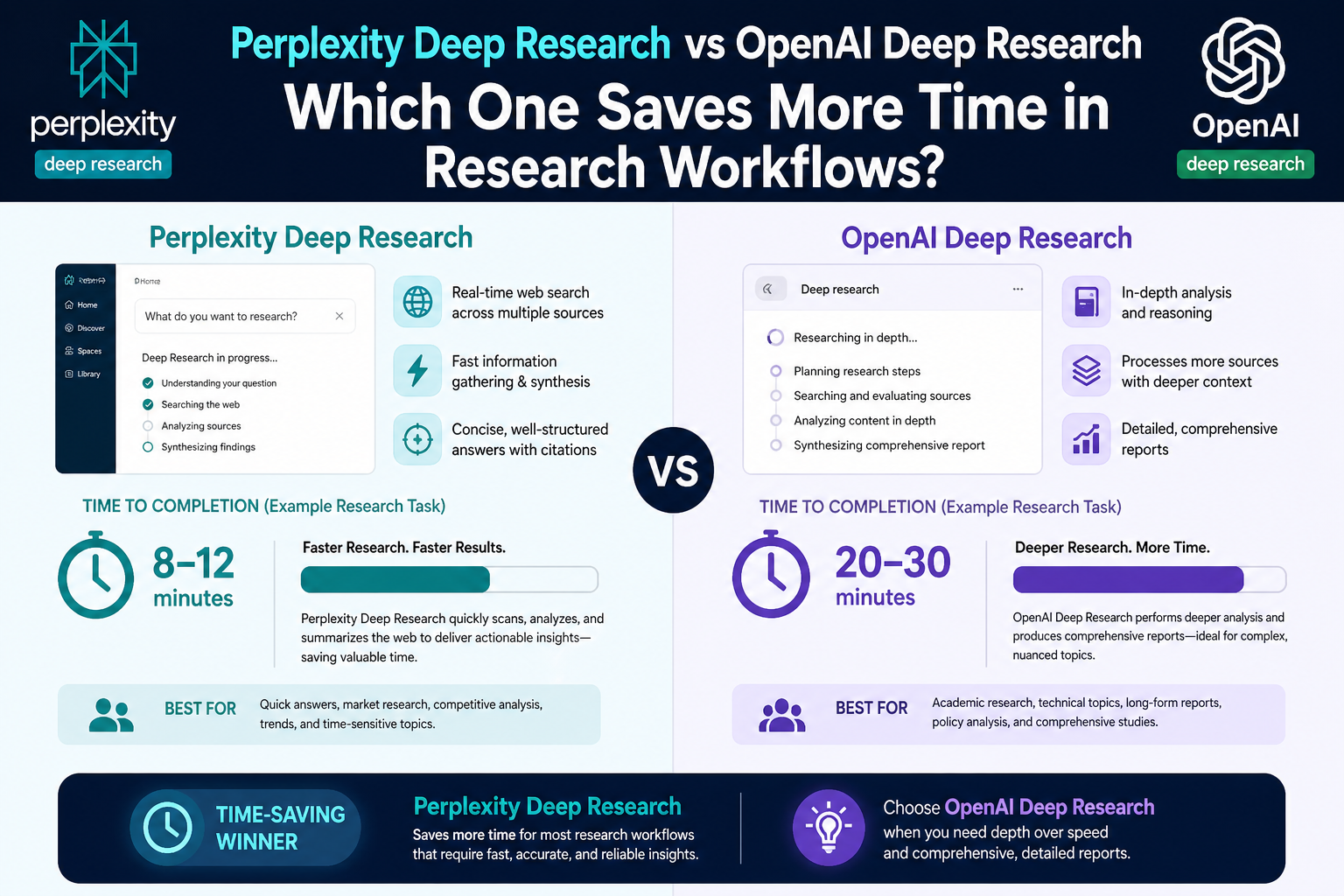
Time is one of the most valuable resources in research, whether you are a student, marketer, or business professional. The faster you can find and understand information, the more productive you become. This is why many people are comparing perplexity deep research vs openai deep research to see which tool actually saves more time in real workflows.
Both Perplexity AI and OpenAI are designed to speed up research, but they do it in different ways.
The Importance of Speed in Research
Research often involves multiple steps such as finding sources, reading information, and analyzing it.
Traditional methods can take hours or even days. AI tools reduce this time significantly.
In perplexity deep research vs openai deep research, the key difference is how each tool optimizes different stages of the process.
Perplexity for Faster Information Gathering
Perplexity AI focuses on quickly retrieving information from the web.
It provides summaries along with sources, which means you do not have to manually search across multiple websites.
This makes it extremely fast for the initial research phase.
OpenAI for Faster Understanding and Analysis
OpenAI reduces the time needed to understand complex information.
Instead of reading multiple sources, you can get a clear and structured explanation in seconds.
This is especially useful for complex topics.
Reducing the Need for Multiple Tools
Without AI, researchers often switch between search engines, articles, and note-taking tools.
Perplexity reduces the need for multiple search steps by combining results and sources.
OpenAI reduces the need for additional explanation tools by providing detailed insights.
Together, they streamline the entire workflow.
Speed vs Depth Trade Off
Perplexity is generally faster when it comes to gathering raw information.
OpenAI may take slightly more time to generate responses, but it provides deeper insights.
In perplexity deep research vs openai deep research, the choice depends on whether you prioritize speed or understanding.
Minimizing Repetitive Work
Research often involves repeating the same steps such as searching, filtering, and summarizing.
Perplexity automates the search and filtering process.
OpenAI automates explanation and summarization.
This reduces repetitive tasks and saves time.
Handling Complex Queries Efficiently
For simple queries, both tools are fast.
For complex queries, OpenAI may save more time because it provides detailed explanations in one response.
Perplexity may require you to review multiple sources.
This difference is important in time-sensitive tasks.
Improving Overall Productivity
By reducing time spent on searching and understanding, both tools improve productivity.
Perplexity helps you move quickly through the research phase.
OpenAI helps you move quickly through the analysis phase.
Using both together creates an efficient workflow.
Limitations in Time Saving
Perplexity may require additional verification if sources are unclear.
OpenAI may require follow-up prompts for more detailed answers.
Understanding these limitations helps you use each tool more effectively.
Conclusion
When comparing perplexity deep research vs openai deep research for saving time, both tools offer strong advantages in different stages of the workflow. Perplexity is faster for gathering information, while OpenAI is faster for understanding and analysis.
The best approach is to combine both tools, allowing you to complete research tasks faster while maintaining accuracy and depth.